To generate economic statistics as per national and international practices for the fulfillment of overall goal of Pakistan Bureau of Statistics.
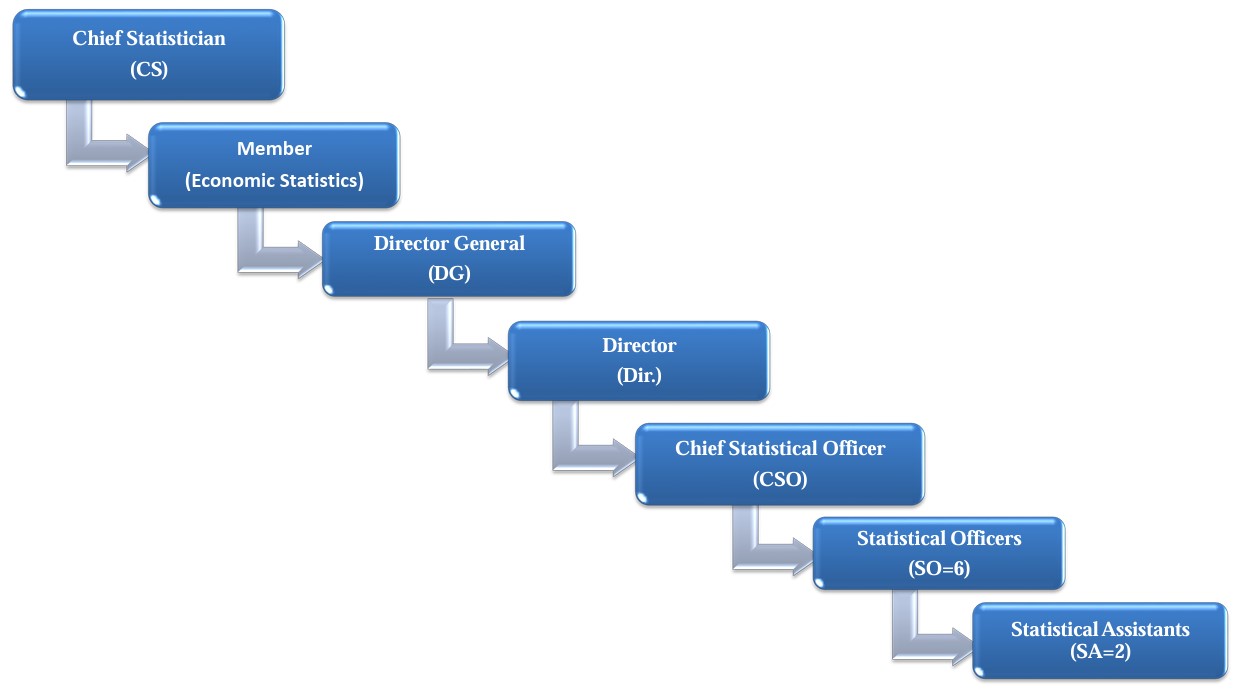
Organogram of Economic Census Section
The 7th Population and Housing Census 2023 marked a historic milestone as Pakistan’s first-ever digital census, conducted under the guidance of the Cabinet Committee and the Council of Common Interests (CCI). Despite an ambitious timeline, the Pakistan Bureau of Statistics (PBS) successfully developed and deployed a comprehensive IT-based system, enabling over 121,000 trained enumerators to digitally cover more than 40 million geo-tagged structures nationwide. Innovative features such as the self-enumeration portal, real-time GIS dashboards, 24-hour call centers, SMS gateways, and Computer-Assisted Telephonic Interviewing (CATI) set new benchmarks for transparency, efficiency, and credibility. For the first time, the census integrated basic economic data with population and housing information, resulting in cost savings of Rs. 7 billion for the government and generating a rich dataset of 250 million individuals, covering demographics, education, employment, and household facilities.
The integration of the Economic Census with the 7th Population and Housing Census 2023 positioned Pakistan alongside international best practices by establishing a unified statistical frame encompassing both population and economic activities. This integration ensured cost efficiency, minimized duplication, and created a consolidated baseline for future surveys while strengthening the national capacity for evidence-based policymaking. It addressed long-standing data gaps, enhancing the government’s ability to monitor socio-economic progress, plan targeted interventions, and respond to emerging challenges. The key objectives included developing an updated national frame of economic establishments, laying the foundation for a Statistical Business Register (SBR), and promoting entrepreneurship and sectoral planning for sustainable economic growth.
The Key features of Digital Integration made for the Economic Census 2023
Pakistan has a total of 38.3 million structures, the majority of which—30.4 million—are normal residential buildings with three or fewer floors. Among the provinces, Punjab leads with 22.1 million structures, followed by Sindh with 7.7 million and KP with 5.7 million. Overall, the data shows that Pakistan’s built environment is dominated by small residential homes.
Multi-story buildings (more than three floors) are relatively rare and primarily found in Sindh, which has 74,882 such buildings. Informal structures such as jhuggis, tents, or caves are also most prevalent in Sindh (313,738) and Balochistan (98,723). Buildings under construction are most common in Punjab (528,470), followed by Khyber Pakhtunkhwa (186,798).
Out of 7 million economic establishments the largest share belongs to the wholesale and retail trade sector, with 2.9 million establishments, followed by agriculture, forestry, and fishing (1.1 million). Other major sectors other service activities (945,013), manufacturing (696,558), education (326,868), and human health and social work (123,973). Based on unit type, the economic landscape includes 2.7 million retail shops, 188,843 wholesale shops, 256k hotels, 119,789 hospitals, 242,616 schools, 11,568 colleges, 214
universities, 600,403 mosques, 19,645 banks, 23,119 factories, 29,836 public offices, and 643,501shop production units.
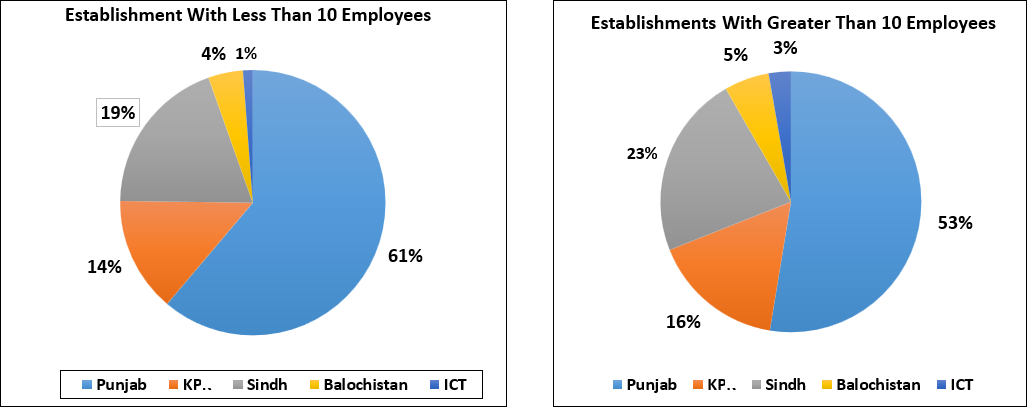
A majority i.e. 95% establishments across Pakistan fall into the category of having fewer than 10 employees, with Punjab having the highest count at 4.1 million. Provincial share of the Establishment with less than 10 employees and greater than 10 employees is as below.
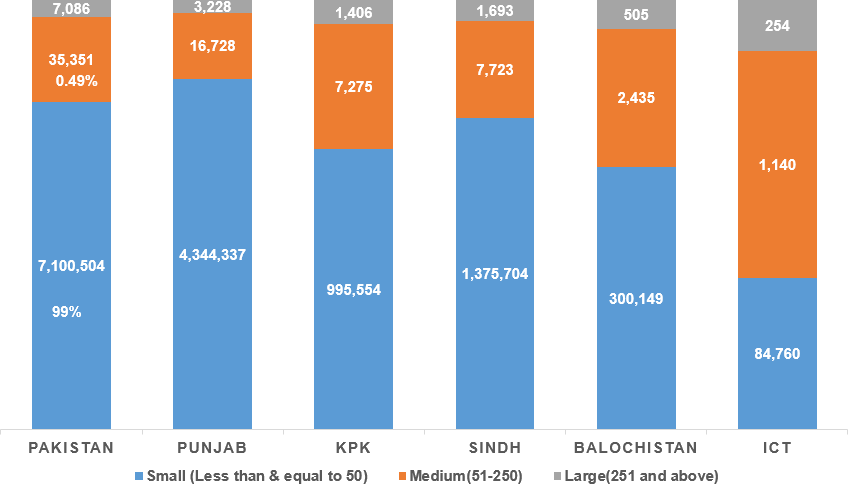
In Pakistan the share of small enterprises is 99% with less than and equal to 50 employees. At the provincial level Punjab holds the largest share (61.18%) in all employment size categories. These categories of Establishments are as per definition of SMEDA
The Economic Census 2023 highlights the pivotal role of household-based economic activities in Pakistan, with 10.9 million establishments engaged in diverse income-generating work. The largest share is animal farming (5.6 million), followed by traditional occupations such as tailoring, embroidery, and carpetmanufacturing, which remain key sources of employment, especially for women and rural communities. Small-scale poultry farming and tuition centers also demonstrate the reliance on household resources to meet local demand. Overall, household economic activities are a vital part of Pakistan’s socio-economic fabric, contributing to livelihoods, women’s empowerment, and income diversification—essential for inclusive and resilient growth.
Main functions of the Economic Census Section:
Planning and Designing the Economic Census
Develops the methodology, concepts, definitions, and classifications in line with international standards (e.g., ISIC).
Prepares census questionnaires, manuals, and field instructions.
Frame Development for Economic Surveys
Maintains and updates the national economic establishments frame, which serves as a sampling frame for subsequent surveys such as the CMI (Census of Manufacturing Industries),SME surveys, or Wholesale and Retail Trade surveys.
Coordination and Implementation
Coordinates with field offices for the enumeration of establishments across all sectors.
Ensures quality control, training of enumerators, and supervision during field operations.
Data Processing and Validation
Oversees data entry, validation, cleaning, and tabulation processes.
Ensures consistency and accuracy through checks and verification systems.
Compilation and Analysis of Results
Produces analytical reports and summary tables on the number, distribution, and characteristics of economic establishments by activity, size, ownership, and region.
Support to Other Statistical Activities
Provides establishment frame and sectoral data for other surveys and studies conducted by PBS or other institutions.
Supports rebasing of national accounts and input-output tables.
Policy and Research Support
Supplies baseline data to policymakers, researchers, and planners for economic policy formulation, investment planning, and regional development analysis.
Documentation and Dissemination
Publishes census results and metadata through reports, online databases, and statistical bulletins.
Ensures transparency and accessibility of information.

 The 7th Population and Housing Census 2023 marked a historic milestone as Pakistan’s first-ever digital census, conducted under the guidance of the Cabinet Committee and the Council of Common Interests (CCI). Despite an ambitious timeline, the Pakistan Bureau of Statistics (PBS) successfully developed and deployed a comprehensive IT-based system, enabling over 121,000 trained enumerators to digitally cover more than 40 million geo-tagged structures nationwide. Innovative features such as the self-enumeration portal, real-time GIS dashboards, 24-hour call centers, SMS gateways, and Computer-Assisted Telephonic Interviewing (CATI) set new benchmarks for transparency, efficiency, and credibility. For the first time, the census integrated basic economic data with population and housing information, resulting in cost savings of Rs. 7 billion for the government and generating a rich dataset of 250 million individuals, covering demographics, education, employment, and household facilities.
The integration of the Economic Census with the 7th Population and Housing Census 2023 positioned Pakistan alongside international best practices by establishing a unified statistical frame encompassing both population and economic activities. This integration ensured cost efficiency, minimized duplication, and created a consolidated baseline for future surveys while strengthening the national capacity for evidence-based policymaking. It addressed long-standing data gaps, enhancing the government’s ability to monitor socio-economic progress, plan targeted interventions, and respond to emerging challenges. The key objectives included developing an updated national frame of economic establishments, laying the foundation for a Statistical Business Register (SBR), and promoting entrepreneurship and sectoral planning for sustainable economic growth.
The 7th Population and Housing Census 2023 marked a historic milestone as Pakistan’s first-ever digital census, conducted under the guidance of the Cabinet Committee and the Council of Common Interests (CCI). Despite an ambitious timeline, the Pakistan Bureau of Statistics (PBS) successfully developed and deployed a comprehensive IT-based system, enabling over 121,000 trained enumerators to digitally cover more than 40 million geo-tagged structures nationwide. Innovative features such as the self-enumeration portal, real-time GIS dashboards, 24-hour call centers, SMS gateways, and Computer-Assisted Telephonic Interviewing (CATI) set new benchmarks for transparency, efficiency, and credibility. For the first time, the census integrated basic economic data with population and housing information, resulting in cost savings of Rs. 7 billion for the government and generating a rich dataset of 250 million individuals, covering demographics, education, employment, and household facilities.
The integration of the Economic Census with the 7th Population and Housing Census 2023 positioned Pakistan alongside international best practices by establishing a unified statistical frame encompassing both population and economic activities. This integration ensured cost efficiency, minimized duplication, and created a consolidated baseline for future surveys while strengthening the national capacity for evidence-based policymaking. It addressed long-standing data gaps, enhancing the government’s ability to monitor socio-economic progress, plan targeted interventions, and respond to emerging challenges. The key objectives included developing an updated national frame of economic establishments, laying the foundation for a Statistical Business Register (SBR), and promoting entrepreneurship and sectoral planning for sustainable economic growth.
 A majority i.e. 95% establishments across Pakistan fall into the category of having fewer than 10 employees, with Punjab having the highest count at 4.1 million. Provincial share of the Establishment with less than 10 employees and greater than 10 employees is as below.
In Pakistan the share of small enterprises is 99% with less than and equal to 50 employees. At the provincial level Punjab holds the largest share (61.18%) in all employment size categories. These categories of Establishments are as per definition of SMEDA
A majority i.e. 95% establishments across Pakistan fall into the category of having fewer than 10 employees, with Punjab having the highest count at 4.1 million. Provincial share of the Establishment with less than 10 employees and greater than 10 employees is as below.
In Pakistan the share of small enterprises is 99% with less than and equal to 50 employees. At the provincial level Punjab holds the largest share (61.18%) in all employment size categories. These categories of Establishments are as per definition of SMEDA
 The Economic Census 2023 highlights the pivotal role of household-based economic activities in Pakistan, with 10.9 million establishments engaged in diverse income-generating work. The largest share is animal farming (5.6 million), followed by traditional occupations such as tailoring, embroidery, and carpet
manufacturing, which remain key sources of employment, especially for women and rural communities. Small-scale poultry farming and tuition centers also demonstrate the reliance on household resources to meet local demand. Overall, household economic activities are a vital part of Pakistan’s socio-economic fabric, contributing to livelihoods, women’s empowerment, and income diversification—essential for inclusive and resilient growth.
The Economic Census 2023 highlights the pivotal role of household-based economic activities in Pakistan, with 10.9 million establishments engaged in diverse income-generating work. The largest share is animal farming (5.6 million), followed by traditional occupations such as tailoring, embroidery, and carpet
manufacturing, which remain key sources of employment, especially for women and rural communities. Small-scale poultry farming and tuition centers also demonstrate the reliance on household resources to meet local demand. Overall, household economic activities are a vital part of Pakistan’s socio-economic fabric, contributing to livelihoods, women’s empowerment, and income diversification—essential for inclusive and resilient growth.